

Cuando llega el verano, también llegan muchas situaciones en las que el inglés puede sacarte de un apuro: pedir algo en un chiringuito, reservar una excursión, hablar del calor, explicar que vas a la playa o simplemente contar tus planes de vacaciones.
¿Por qué aprender vocabulario de verano en inglés?
El verano es una de las mejores épocas para ampliar vocabulario porque todo es muy visual. Además, muchas conversaciones de verano son bastante repetidas. Hablamos del tiempo, de viajes, de planes, de comida, de ropa cómoda, de playa, de piscina y de actividades al aire libre. Si dominas esas palabras, puedes mantener conversaciones sencillas sin quedarte bloqueado.
Summer vocabulary básico: palabras de verano que debes conocer
Vamos a empezar por el vocabulario más básico. No hace falta aprenderlo todo de golpe. Lo mejor es que agrupes las palabras por situaciones. Así tu cabeza no guarda una lista desordenada, sino pequeñas escenas: un día de playa, una tarde en la piscina, una maleta de verano o una conversación sobre el calor.
Clima y sensaciones del verano en inglés
Para hablar del verano, necesitas saber describir el tiempo. En inglés, las frases sobre el clima se construyen normalmente con “It’s”. Por ejemplo, no decimos “the day is hot” como traducción directa de “el día está caluroso”, sino “It’s hot”.
Español | Inglés | Ejemplo |
Hace calor | It’s hot | It’s really hot today. |
Hace sol | It’s sunny | It’s sunny, so let’s go out. |
Hace bochorno | It’s humid | It’s very humid near the coast. |
Ola de calor | Heat wave | We’re having a heat wave this week. |
Brisa | Breeze | There’s a nice breeze today. |
Cielo despejado | Clear sky | The sky is clear this morning. |
Quemadura solar | Sunburn | I got sunburn yesterday. |
Bronceado | Tan | She has a nice tan. |
Sudar | To sweat | I’m sweating because it’s too hot. |
Refrescarse | To cool off | Let’s cool off in the pool. |
Playa, piscina y objetos imprescindibles
Si vas a la playa o a la piscina, hay palabras que vas a usar constantemente. Algunas son muy fáciles, pero otras suelen confundirse.
Español | Inglés | Ejemplo |
Playa | Beach | We’re going to the beach. |
Piscina | Swimming pool / Pool | The hotel has a pool. |
Arena | Sand | The sand is very hot. |
Mar | Sea | I love swimming in the sea. |
Ola | Wave | The waves are quite big today. |
Toalla | Towel | Don’t forget your towel. |
Sombrilla | Beach umbrella | We rented a beach umbrella. |
Crema solar | Sunscreen | You should put on sunscreen. |
Gafas de sol | Sunglasses | I can’t find my sunglasses. |
Flotador | Float | The child is using a float. |
Cubo | Bucket | The kids are playing with a bucket. |
Pala | Spade | They’re building a sandcastle with a spade. |
Castillo de arena | Sandcastle | Let’s build a sandcastle. |
Chiringuito | Beach bar | We had lunch at a beach bar. |
Ropa de verano en inglés
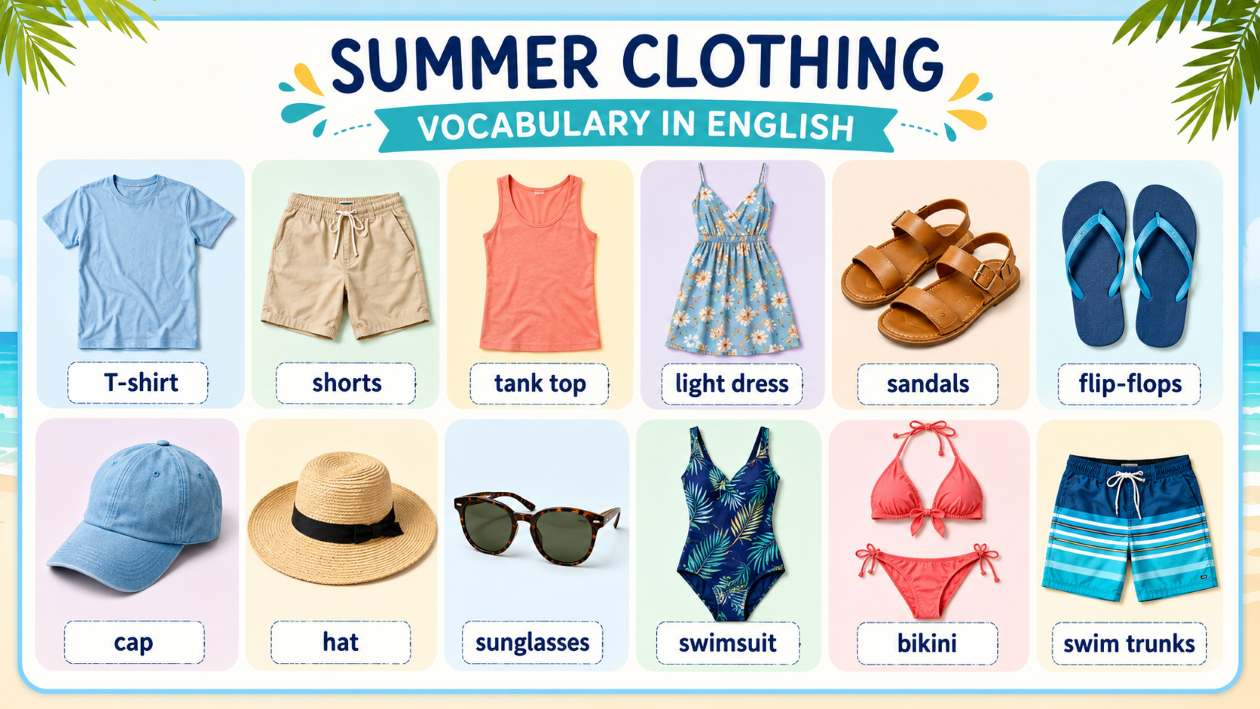
La ropa de verano es uno de los bloques más buscados porque aparece en viajes, tiendas, maletas y conversaciones cotidianas. Además, muchas palabras son muy visuales, así que conviene aprenderlas con imágenes.
Español | Inglés | Ejemplo |
Camiseta | T-shirt | I’m wearing a white T-shirt. |
Camiseta sin mangas | Tank top | He bought a new tank top. |
Pantalones cortos | Shorts | I need some shorts for the trip. |
Vestido ligero | Light dress | She wore a light dress. |
Falda | Skirt | This skirt is perfect for summer. |
Sandalias | Sandals | These sandals are very comfortable. |
Chanclas | Flip-flops | Don’t wear flip-flops for a long walk. |
Gorra | Cap | Take a cap, it’s very sunny. |
Sombrero | Hat | I always wear a hat at the beach. |
Bañador | Swimsuit | I packed my swimsuit. |
Bikini | Bikini | She bought a new bikini. |
Bañador masculino | Swim trunks | He forgot his swim trunks. |
Ropa de baño | Swimwear | This shop sells swimwear. |
Comida y bebida típica del verano
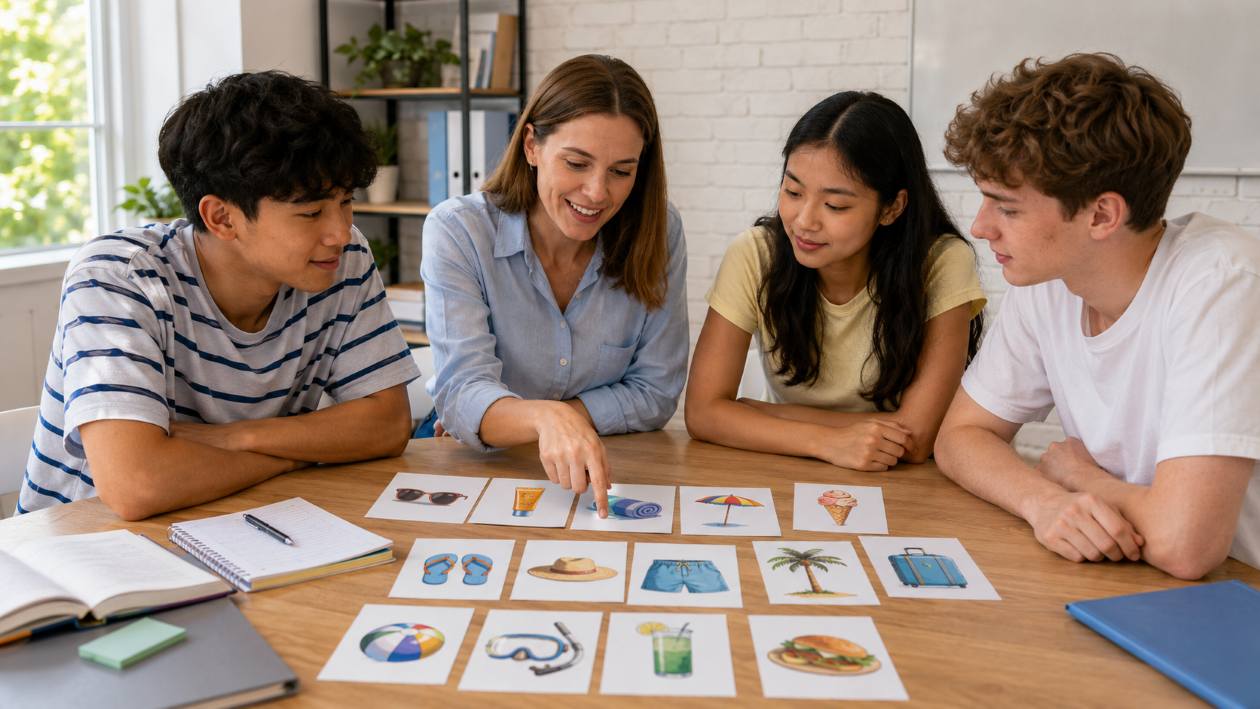
En verano también hablamos mucho de comida fresca, helados, bebidas frías y comidas al aire libre. Este vocabulario te servirá tanto para viajar como para mantener conversaciones informales.
Español | Inglés | Ejemplo |
Helado | Ice cream | I’d like an ice cream. |
Polo | Ice lolly / Popsicle | The kids want a popsicle. |
Sandía | Watermelon | Watermelon is perfect in summer. |
Limonada | Lemonade | Let’s make some lemonade. |
Café con hielo | Iced coffee | I usually drink iced coffee in summer. |
Té helado | Iced tea | Can I have an iced tea? |
Batido | Smoothie | This mango smoothie is delicious. |
Ensalada | Salad | I prefer a salad when it’s hot. |
Barbacoa | Barbecue / BBQ | We’re having a barbecue tonight. |
Marisco | Seafood | We ate seafood by the sea. |
Bebida fría | Cold drink | I need a cold drink. |
Actividades de verano en inglés
El verano no es solo playa. También puede ser camping, senderismo, viajes, excursiones, festivales o tardes con amigos. Para hablar de actividades, normalmente usamos verbos como “go”, “do”, “play” o directamente el verbo principal.
Español | Inglés | Ejemplo |
Nadar | To swim | I swim every morning. |
Tomar el sol | To sunbathe | They’re sunbathing on the beach. |
Viajar | To travel | We love to travel in summer. |
Acampar | To camp | We’re going to camp near the lake. |
Hacer senderismo | To go hiking | Let’s go hiking tomorrow. |
Hacer surf | To surf | He learned to surf last summer. |
Bucear | To dive | I want to dive in the sea. |
Hacer snorkel | To go snorkeling | We went snorkeling in the morning. |
Navegar | To sail | They sailed along the coast. |
Pescar | To go fishing | My uncle likes to go fishing. |
Hacer una excursión | To go on a trip | We went on a day trip. |
Relajarse | To relax | I just want to relax. |
Refrescarse | To cool off | Let’s cool off with a swim. |
Hacer una barbacoa | To have a barbecue | We had a barbecue on Saturday. |
Vocabulario de verano en inglés para viajar
Si vas a viajar en verano, el vocabulario cambia un poco. Ya no basta con saber decir “beach” o “sunglasses”. También necesitas moverte por aeropuertos, alojamientos, restaurantes y transporte.
En el aeropuerto y durante el viaje
Español | Inglés | Ejemplo |
Vuelo | Flight | What time is your flight? |
Billete | Ticket | I can’t find my ticket. |
Tarjeta de embarque | Boarding pass | Here is my boarding pass. |
Equipaje | Luggage | Where is the luggage area? |
Equipaje de mano | Hand luggage / Carry-on | This is my carry-on. |
Maleta | Suitcase | My suitcase is very heavy. |
Puerta de embarque | Gate | Our gate is number 12. |
Retraso | Delay | The flight has a delay. |
Pasaporte | Passport | Don’t forget your passport. |
Aduana | Customs | We have to go through customs. |
En el hotel o un alojamiento
Español | Inglés | Ejemplo |
Reserva | Reservation / Booking | I have a reservation. |
Habitación | Room | The room is very comfortable. |
Recepción | Reception / Front desk | Ask at reception. |
Aire acondicionado | Air conditioning | Does the room have air conditioning? |
Desayuno incluido | Breakfast included | Is breakfast included? |
Llave | Key | I lost my room key. |
Salida del hotel | Check-out | What time is check-out? |
Entrada al hotel | Check-in | Check-in starts at 3 p.m. |
Alojamiento | Accommodation | We’re looking for accommodation. |
En España solemos decir “hotel” para casi todo, pero en inglés “accommodation” es una palabra más general. Puede incluir hotel, apartamento, hostal, casa rural o cualquier lugar donde te alojes.
En restaurantes, chiringuitos y cafeterías
Español | Inglés | Ejemplo |
Menú / carta | Menu | Can I see the menu, please? |
Cuenta | Bill / Check | Can we have the bill, please? |
Mesa | Table | We booked a table for two. |
Camarero/a | Waiter / Waitress / Server | The server was very kind. |
Bebida | Drink | Would you like a drink? |
Agua fría | Cold water | Can I have some cold water? |
Plato del día | Dish of the day | What’s the dish of the day? |
Soy alérgico a… | I’m allergic to… | I’m allergic to nuts. |
Pagar con tarjeta | Pay by card | Can I pay by card? |
Gracias a este tipo de artículos, te obligas a usar el vocabulario en un contexto determinado, pero si además quieres mejorar tu inglés, apúntate a nuestro curso de inglés B1 (PET), te ayudaremos a prepararte para poder conseguir el nivel B1 y así examinarte para conseguir el título.